Why Your Makeup Looks Different in Photos:
The Science Behind Camera-Ready Beauty
Have you ever looked in the mirror and thought your makeup was flawless, only to see a completely different result in a photograph?
You are not imagining it.
Makeup is experienced by the human eye in three dimensions, under changing light and with natural movement. A camera captures a single, two-dimensional moment. It records light, color, contrast, texture, and reflection in ways that can make makeup appear heavier, flatter, warmer, cooler, or more textured than it looked in person.
After years of working with brides, models, editorial productions, and fashion shows, I have learned that camera-ready makeup is not necessarily about using more product. It is about understanding how makeup interacts with light and the lens.
The Face You See vs. the Face the Camera Sees
A mirror gives you immediate visual information, but a photograph freezes everything.
When we look at someone’s face in person, our eyes naturally adjust to different levels of brightness and color. A camera does not do this in quite the same way. Depending on the camera, lens, exposure, white balance, and lighting, the same makeup can look completely different.
This is why a foundation that looks seamless in the mirror can suddenly appear heavier in photographs, or why blush that seems subtle in person may almost disappear on camera.
The goal is not to fight the camera. It is to understand it.
Lighting Changes Everything
Lighting is one of the most important elements in how makeup photographs.
Soft, diffused natural light tends to reveal skin beautifully. Direct flash can emphasize shine and texture. Warm indoor lighting can make foundation and blush appear more yellow or orange. Cool lighting can make the complexion look washed out.
In fashion and editorial work, makeup artists often know the lighting environment before creating the final look. The makeup is designed not only for the face, but also for the conditions in which that face will be photographed.
For bridal clients, this becomes especially important. A bride may spend part of her day in a hotel room, move outdoors for portraits, enter a dim reception space, and later be photographed with flash. Her makeup needs to translate through all of those environments.
Texture Is Everything
One of the biggest misconceptions about camera-ready makeup is that more coverage automatically means better photographs.
In reality, excessive product can sometimes make skin look less natural on camera.
Heavy layers of foundation, concealer, and powder can collect around pores, fine lines, and areas of natural movement. What looks polished from several feet away can become much more noticeable in a high-resolution photograph.
I prefer to think of the skin as a surface rather than something that needs to be completely erased.
The goal is to create an even, luminous complexion while allowing the skin to retain dimension.
Thin layers, strategic coverage, and carefully placed powder often photograph more beautifully than one heavy layer across the entire face.
The SPF and Flashback Question
SPF is an important part of everyday skincare, but when photography with flash is involved, product selection can become more nuanced.
Certain sunscreen and complexion products containing highly reflective ingredients can contribute to a pale or whitish cast under specific lighting conditions. This is often referred to as flashback.
That does not mean you should simply avoid sunscreen. Instead, professional makeup artists consider the entire combination of skincare, complexion products, lighting, and photography conditions.
For an important event or photoshoot, it is always better to test the complete routine beforehand rather than discovering how products react to flash on the day itself.
High-Resolution Cameras See Everything
Modern cameras capture an incredible amount of detail.
That is wonderful for editorial photography—but it also means that skin texture, excessive powder, unblended edges, and color transitions can become much more visible.
The irony is that truly camera-ready makeup can sometimes look almost too subtle when you are standing in front of a mirror.
That is completely normal.
Professional makeup for photography is often about creating dimension that the camera can interpret correctly without making the makeup itself look obvious.
Why “Natural” Makeup Can Be Technically Difficult
A natural makeup look may appear effortless, but creating it professionally can require considerable precision.
When there is less makeup to hide behind, every detail becomes more important: the placement of concealer, the transition between foundation and bare skin, the shape of the brows, the amount of powder, the reflection on the high points of the face, and the balance of color.
This is why “ no-makeup makeup ” is not necessarily no makeup.
It is controlled makeup designed to look like skin.
Skin Preparation Comes First
Beautiful makeup begins before the foundation.
The way skincare is layered can influence how makeup sits, reflects light, and wears throughout the day. Overloading the skin with products can cause makeup to move, while insufficient preparation can leave the complexion looking dry or uneven.
I think of skin preparation as part of the makeup itself.
My approach has always been to treat the skin almost like a piece of jewelry: the goal is not to cover its natural character, but to make it look healthy, polished, and luminous.
When the skin is prepared correctly, you often need less foundation to achieve a refined result.
One Makeup Look Does Not Work for Every Camera
A runway, a wedding, a red carpet, and an editorial shoot all require different approaches.
Fashion makeup may need to communicate a strong concept from a distance. Bridal makeup has to survive hours of movement and photograph beautifully in changing environments. Editorial makeup can be more experimental because the image itself is the final artistic product.
Even the distance between the subject and the camera can change how makeup reads.
There is no universal “ camera-ready ” face.
There is only makeup designed for a particular person, environment, light, and visual story.
Look Through the Lens
One of my favorite professional habits is simple: check the makeup through the camera.
A quick photograph can reveal things that are difficult to see in a mirror—uneven blending, excessive shine, disappearing blush, or a foundation shade that behaves differently under the lighting.
The camera becomes another tool in the makeup artist’ s kit.
And this is one of the biggest differences between doing makeup for yourself and creating makeup professionally. A professional makeup artist is not only asking, “Does this look beautiful in the mirror?”
We are also asking:
How will this look in natural light?
How will it look under flash?
How will the skin texture translate through a high-resolution lens?
Will the color still have dimension in a photograph?
Will this still look like the person – or like a layer of makeup?
Camera-Ready Beauty Is Still About Real Beauty
The best camera-ready makeup does not create a different face.
It translates the real face beautifully through the lens.
For me, that is the essence of modern makeup artistry. Beauty does not have to mean hiding texture, changing features, or adding layer after layer of product. It can mean understanding light, respecting the architecture of the face, and using makeup precisely enough that the result feels effortless.
Camera-ready beauty isn’t about wearing more makeup. It’s about understanding how light, texture, color, and skin interact with the lens.
And when those elements work together, the photograph doesn’t look like a heavily made-up face.
It simply looks like you, beautifully captured.
The experienced beauty professionals at Rich Beauty Studio will help you create the perfect look for any photoshoot or special event.
About the Author
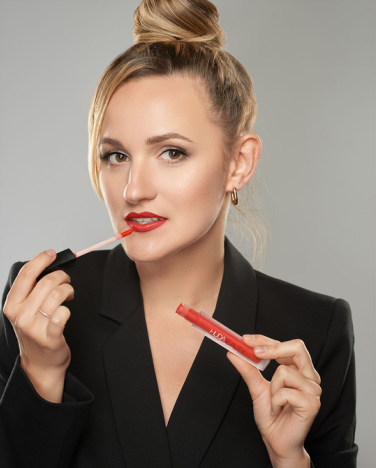
Katya Rich is a licensed cosmetologist, beauty expert, hairstylist, and awardwinning makeup artist. She is a regular participant in Fashion Weeks in New York, Los Angeles, and San Francisco. Katya is the founder and lead artist of Rich Beauty Studio in San Francisco.
For more information, visit katyarich.com and follow her on Instagram: @katya.rich.makeup.
Photo Credits
Photographer: Jeramie Campbell
Stylist: Bryan George Calloway